
Object Record
Images
Metadata
Catalog Number |
2018.5.9 |
Object Name |
|
Description |
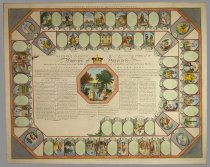
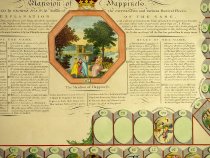
Laurie and Whittle's New Moral and Entertaining Game of The Mansion of Happiness. Game invented by George Fox. This edition published by Richard Holmes Laurie in London, England in 1851. Laurie and Whittle's "The Mansion of Happiness," originally published by Robert Laurie and James Whittle in 1800, is one of a burgeoning category of games of "social betterment" popularized in Europe and America around that time. The game has 67 compartments representing various virtues and vices. Players were rewarded for truth, temperance, and hard work, and punished for landing on spaces representing vices. In the center of the print, the "Mansion of Happiness" is actually Oaklands Park, the residence of the Duke and Duchess of York (the game was dedicated to the Duchess). "The Mansion of Happiness," was particularly harsh in comparison to other moral games of its time. Addressing the serious crimes of theft, cheating, and drunkenness, it prescribed penalties including prison, whipping, and the stocks. It was also noted for giving its inventor's name, George Fox. An 1843 American version of the game is widely considered to be the first American board game (it was actually mounted on cardboard), though publishers had been producing geographical games on linen since the 1820s. The game, published from 1800 in England to 1926 in the US, is the longest continuously published board game with a known designer. |
Title |
Laurie and Whittle's New Moral and Entertaining Game of The Mansion of Happiness (Virtue Rewarded and Vice Punished) |
Date |
1851 |
Role of Creator |
Publisher |
Creator |
Laurie, Richard Holmes |
Medium |
hand color engraving |
Material |
paper |
Dimensions |
H-18.5 W-23.25 inches |
Credit line |
Museum purchase made possible by Orrin Lippoff |
Place of Origin |
Europe/United Kingdom/England |
Subjects |
Games Moral & ethical aspects Vice Victorian Play |