
Object Record
Images
Metadata
Catalog Number |
2017.10.4 |
Object Name |
Painting |
Description |
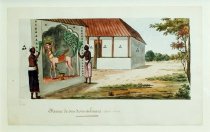
Indian trade watercolor captioned in French, "Montuze du dieu des musulmans, appelée bouratk (?)," 1818-1828. Produced for the French trade in India. This is an example of a trade watercolor made by an Indian artist for a French consumer. Eighteenth and nineteenth century European travelers to India wanted to collect or send images of their travels home, and often hired Indian painters to do the job. These paintings, done in a European style and palette are known as "Company" paintings, and are characterized by the use of watercolors and the use of linear perspective and shading. The French title on the work, "Montuze du Dieu Musulmans, Appelee Bourath" is misspelled, indicating that whoever wrote it was not a native French speaker. Presumably, it is meant to translate to "Mount of the Muslim God - Called Buraq." It is unclear if the artist sold this alongside other paintings to a French person who then inscribed the painting, or if it was sold as a set with the inscriptions in French already written. Buraq is a steed from Islamic muythology, who carried the Prophet Muhammad from Mecca to Jerusalem and back in the Isra and Mi'raj or "Night Journey," as recounted in hadith literature. Near Eastern and Persian art almost always portrays Buraq with a human face-a visual convention that eventually found its way into Indian art. The scholar consulted on this painting is uncertain whether the artist is depicting Buraq being stored in an Imambara to be processed during Muharram. An imambarra is a building, rooms, etc., used by Shi?ites for ceremonies, especially during the first 10 days of Muharram, which is the Shi'a period of mourning. It is also possible that this is a depiction of Kamadhenu, the Hindu divine cow goddess of plenty also known as Surabhi, simply being worshipped as a Hindu God. However, a Hindu god would usually be inside a temple in the sanctum, rather than in an open-air niche as depicted here. Either option is probable, as Hindu-Muslim confusion can occur, especially among Europeans, since during festivals a lot of the icons can be used in both traditions, and since Muharram was celebrated in South India. The title, full of misspellings, most likely indicates that the painting was done by an Indian artist for the French trade. The title probably is meant to read, "Monture du dieu des musulmans, appelée buraq," which translates as "Mount of the god of Muslims, called Buraq." This is a misnomer as the cow goddess depicted in the painting resembles Kamadhenu, a Hindu goddess of plenty who is depicted as a white cow with a crowned, female face, and eagle wings. By the early 19th century, some depictures of the goddess showed her with a peacock tail of Buraq, the steed that the prophet Muhammad rode to heaven on his nigh journey (Miraj). According to scholarship from the Philadelphia Museum of Art, the composite Indo-Persian depictions that emerged during this time may be some of the earliest to merge Kamadhenu with the Islamic Buraq. The artists have mislabeled the Kamadhenu as a Muslim "god," demonstrating either French desires, or their own conflation of the two religions. |
Title |
Monture du dieu des musulmans, appelée bouratk |
Date |
1818-1828 |
Creator |
Unknown (Indian School) |
Medium |
watercolor |
Material |
paper |
Dimensions |
H-12 W-19 inches |
Credit line |
Museum purchase made possible by Michael and Kathy Mouron |
Place of Origin |
Asia/India |
Subjects |
Colonialism Colonies Hindu temples Hinduism Islam Tourism Tourist art Trade Travel |